A Scientific Guide to Professional Enhancements
DeEnterprises Handbook of Acrylic Nails
A Scientific Guide to Professional Enhancements
Welcome to the Science of Nail Technology!
The DeEnterprises Handbook of Acrylic Nails is not just a standard how-to guide; it is your definitive roadmap to mastering the chemistry, anatomy, and structural engineering behind flawless artificial enhancements. Whether you are a beginner building your foundational knowledge or a seasoned professional looking to elevate your troubleshooting skills and chemical understanding, this guide demystifies the products at your station. Step away from guesswork, understand the “why” behind the “how,” and elevate your artistry through the power of precision science.
|
||
|
|
Chapter 1: Introduction to Acrylic Chemistry Chapter 2: The Technician’s Tool Kit |
|
|
🏁 UNIT 1 CONCLUSION: THE FOUNDATION IS SET You now possess the biological and chemical knowledge required of a true professional. By understanding the core mechanics of acrylic chemistry, utilizing chemically inert tools at your station, respecting the living anatomy of the natural nail, and enforcing strict decontamination standards, you have set the stage for safe, masterful application. The environment is clean, and the tools are ready. Next, we prepare the canvas. |
||
🔗UNIT 2: CHEMICAL PREPARATION & ADHESION🔗A beautiful enhancement is only as strong as its bond to the natural nail. In this unit, we explore the crucial intersection where physical preparation meets DeEnterprises’ advanced adhesion chemistry. You will learn how to expertly prepare the natural nail plate through mechanical micro-etching, precise dehydration, and specialized pH balancing for a secured, long-lasting, and lift-resistant foundation. |
||
|
Chapter 5: Mechanical Prep (The Foundation) |
|
|
|
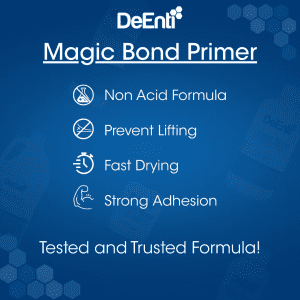
🏁 UNIT 2 CONCLUSION: THE PERFECT BOND The natural canvas is now perfectly engineered for adhesion. You have mastered the delicate balance of mechanical micro-etching without causing biological damage. You have optimized the surface environment using DeEnterprises PH Plus Bonder, and you have established an unbreakable, non-acid covalent bond with Magic Bond Primer. With the nail protected and prepped, you are finally ready to trigger the chemical reaction. |
||
💥UNIT 3: THE REACTION (POLYMERIZATION)💥With the canvas perfectly prepped, it is time to trigger the chemistry. This unit takes a microscopic look at the actual ingredients that build your enhancements. By understanding the specific roles of the monomer liquid, the polymer powder, and the precise chemical reaction that occurs when they meet, you gain total mastery over your bead consistency, curing times, and the structural integrity of your final work. |
||
|
|
||
|
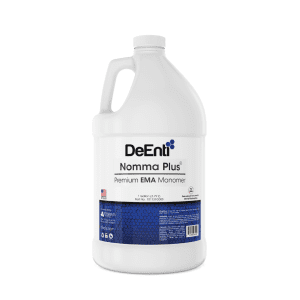
🏁 UNIT 3 CONCLUSION: MASTERING THE MIX You now understand the microscopic collision that builds your enhancements. By recognizing the specific roles of the Nomma Plus Monomer and the BPO-infused polymer, and by mastering the precise ratio required to trigger flawless cross-linking, you have taken total control of the polymerization process. With the chemistry successfully activated and balanced, it is time to engineer the enhancement’s physical shape. |
||
🏛️UNIT 4: STRUCTURAL ENGINEERING🏛️With the chemical reaction mastered, your role shifts from chemist to architect. A durable enhancement relies on more than just high-performance products; it requires precise physical design. In this unit, we explore the architectural mechanics of the apex, the systematic protocols for perfect product application, and how to expertly adapt your technique to the invisible variables of your salon’s environment. Mastering these elements ensures your work endures the daily physical stresses of your client’s life. |
||
|
Chapter 12: The Architecture of the Apex Chapter 13: The Application Methods Chapter 14: Environmental Chemistry (Temperature & Humidity) |
|
|
|
🏁 UNIT 4 CONCLUSION: MASTERING THE ARCHITECTURE You have successfully bridged the gap between chemical knowledge and physical application. By engineering a proper apex for structural integrity, executing precise application methods, and understanding how to adapt your technique to your salon’s ambient temperature, you can now confidently construct enhancements that are as resilient as they are beautiful. But even the best professionals encounter anomalies. Next, we tackle troubleshooting and chemical removal. |
||
🔍UNIT 5: TROUBLESHOOTING & BREAKDOWN🔍In the real world of the salon, anomalies happen. A true professional separates themselves not just by how they apply the product, but by how they diagnose issues and protect the biological canvas during removal. This final unit equips you with the analytical skills to swiftly troubleshoot common structural failures like lifting and discoloration, and outlines the precise chemical protocols for safe, damage-free breakdown. |
||
|
|
Chapter 15: Diagnosing Lifting |
|
|
🏁 UNIT 5 CONCLUSION: THE COMPLETE PROFESSIONAL You have come full circle. By mastering the art of troubleshooting and enforcing strict, safe removal protocols, you ensure that the integrity of the natural nail is never compromised. You are no longer just applying a product; you are managing the complete lifecycle of a chemical service with the utmost professional care. |
||
|
|
||