Groundwork for safe, predictable, and masterful application
Chapter 1: Introduction to Acrylic Chemistry

The Molecular Engineering of Professional Enhancements
Every time you sit down at your manicure table, you aren’t just a stylist—you are an applied chemist. While we engineer these high-performance formulas in the DeEnterprises laboratory, you are the one responsible for executing the final scientific reaction in the booth. Mastering this craft requires moving beyond the “how” and understanding the “why” of the chemistry at your station.
The Biological Barrier: Why Molecular Weight Matters
Safety in nail technology is a matter of physics. There is a sharp divide between professional Ethyl Methacrylate (EMA) and hazardous, often illegal Methyl Methacrylate (MMA).
- MMA (The Hazard): These are tiny, low-molecular-weight molecules. Because of their small size, they easily permeate the nail plate and skin’s lipid barrier, leading to deep-tissue sensitization and “shredded” keratin fibers.
- EMA (The DeEnterprises Standard): We formulate exclusively with the highest-purity EMA. These molecules have a much higher molecular weight, and are physically larger. This creates a Biological Barrier; the molecules are too large to penetrate the nail plate or be absorbed into the bloodstream.
Expert Insight: By utilizing large-molecule chemistry, DeEnterprises ensures the enhancement stays safely on the keratin canvas, protecting both the technician and the client.
Nomma Plus: The Monomer (The Liquid Carrier)
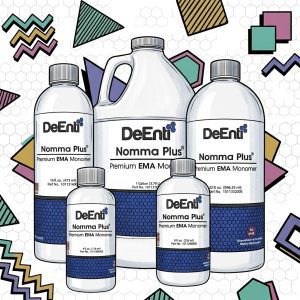 Nomma Plus Monomer is a low-viscosity EMA carrier solution. Its professional performance is driven by a proprietary stabilization matrix:
- Tertiary Amine (The Activator): The chemical “spark” that enables the system to cure at room temperature without external heat.
- Optical Brightening System: We utilize D&C Violet No. 2 to serve a functional, rather than aesthetic, purpose. Because violet sits opposite yellow on the visible light spectrum, these molecules act as a filter, neutralizing the wavelengths that cause polymer degradation and environmental yellowing.
- Inhibitors: High-performance agents that prevent premature molecular “linking,” ensuring bottle stability and consistent flow.
DeEnterprises Polymer (The Powder Base)
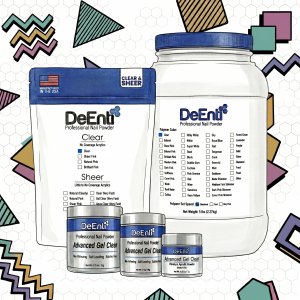 Our DeEnterprises powders consist of microscopic spheres engineered through Suspension Polymerization.
- Initiator Infusion: Each sphere is infused with Benzoyl Peroxide (BPO).
- Multi-Functional Logic: Many inferior powders lack a sufficient BPO load and will never properly cure with any liquid monomer. DeEnterprises powders are calibrated with a high-density initiator load, making them truly multi-functional for both traditional liquid-and-powder services and professional dip systems.
The Synthesis: How the Reaction Happens
When the monomer liquid “wets out” the polymer spheres, you trigger Free Radical Addition Polymerization. This is a three-step chemical chain reaction:
- Activation: The Tertiary Amines in the liquid collide with the BPO in the powder, “waking up” the initiator and releasing Free Radicals.
- Cross-Linking: The molecules weave together into a dense, three-dimensional grid. This is an Exothermic Reaction, meaning it releases a small, safe amount of heat as a byproduct of the molecules bonding.
- The Result: A protective, interlocking molecular structure that delivers the impact resistance of a high-tech polymer and the aesthetic clarity of glass.
As a professional, you are the conductor of this reaction. Your mastery over ratio, contamination, and temperature dictates the strength and durability of the final structure.