Take a microscopic look at the actual ingredients that build your enhancements
Chapter 10: The Chemical Reaction
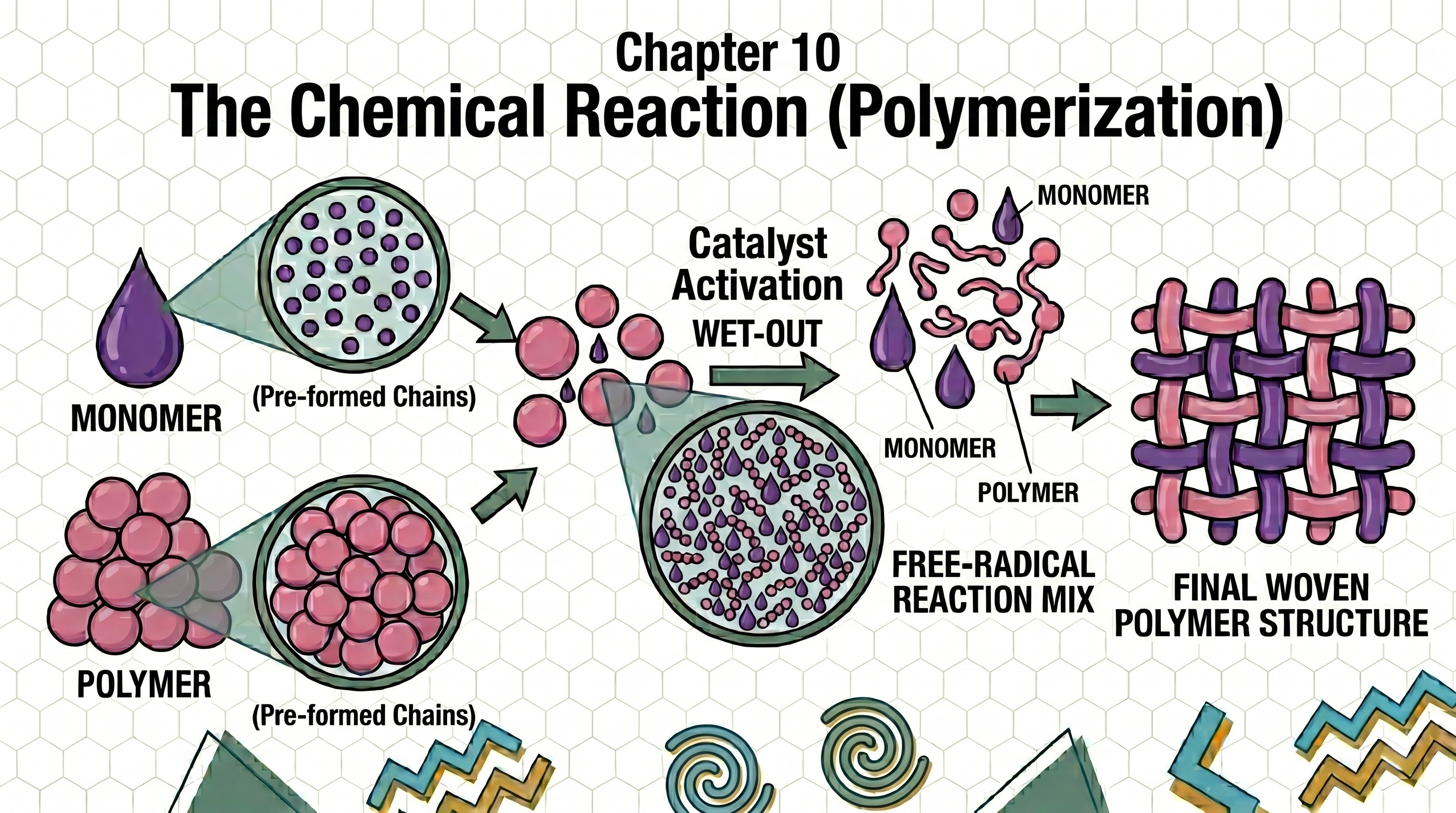
The Science of Polymerization
How do a free-flowing liquid and a fine powder combine to form a tough, durable enhancement? It isn’t magic—it is the precise science of polymerization. When your professional Kolinsky brush brings the translucent purple Nomma Plus Monomer to the engineered polymer powder, the chemical activators in the liquid immediately wake up the BPO catalyst waiting within the powder spheres.
In an appropriate ratio, the liquid perfectly wets out these spheres, causing the individual monomer molecules and the pre-formed polymer chains to link arms. As they bind, they weave together into a tight, three-dimensional network known as cross-linking.
 During this structural transformation, the mixture undergoes an exothermic reaction—meaning it actively releases a small, safe amount of heat as a natural byproduct of the molecules bonding. The bead size is also directly correlated to the amount of heat generated. In addition to size, a “wet” bead containing too much monomer has more reactive sites, thus a faster energy release and a higher “burn” – another reason why proper ratio control is essential for client comfort.
Within minutes, this dynamic chemical process hardens the mixture into a protective, interlocking grid, curing into a final enhancement that delivers both exceptional strength and essential flexibility.