Ensuring your work endures the daily physical stresses of your client's life
Chapter 14: Environmental Chemistry (Temperature & Humidity)
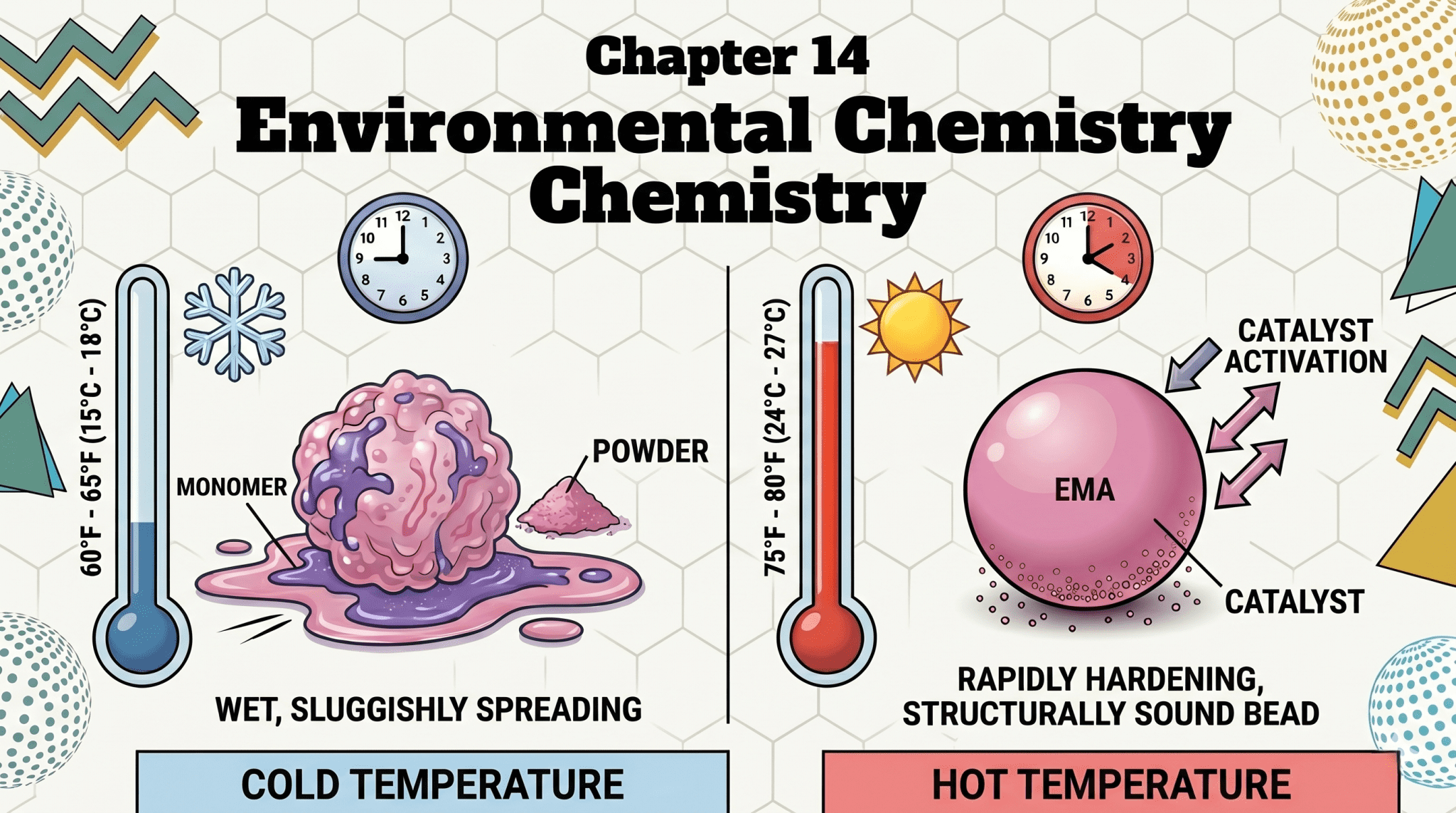
🌡️ The Invisible Variables 🌡️
Even with flawless mechanical prep and perfectly mastered bead ratios, there are two invisible variables at your salon station that act as “silent partners” in the polymerization process: Ambient Temperature and Relative Humidity. Because the reaction between Nomma Plus Monomer and our polymer powder is a delicate chemical exchange, your environment dictates the speed, clarity, and structural integrity of the finish.
-
Temperature: The Kinetic Accelerator –
Polymerization is a temperature-sensitive process. In chemistry, heat is energy that dictates the kinetic motion of molecules.
-
- Heat Speeds Up the Reaction: In an excessively warm salon (above 78°F), the chemical activators in the monomer and the BPO catalysts in the powder become highly reactive. The molecules “link arms” at an accelerated rate, which significantly reduces your working time and can lead to “flash setting.”
- Cold Slows Down the Reaction: In a cold environment (below 68°F), molecular motion becomes sluggish. Your beads will stay wetter for a longer duration, extending your working time but increasing the risk of the product “running” and flooding the eponychium before it can begin to stabilize.
-
Humidity: The Moisture Barrier –
While temperature dictates the speed of the cure, humidity often dictates the clarity and adhesion of the enhancement.
-
- High Humidity (The “Clouding” Risk): When the air is saturated with water vapor, microscopic water molecules can become trapped within the polymer network during the mixing process. This is known as interstitial moisture entrapment.
- The DeEnterprises Solution: To combat this, Nomma Plus is engineered as a sophisticated Copolymerization Blend. Unlike standard monomers that rely on a single building block, our formula utilizes a strategic array of moisture-scavenging agents and high-density cross-linkers. These components are calibrated to prioritize the molecular bond and neutralize environmental moisture during the critical polymerization phase. While other liquids may turn “milky” in high-humidity regions, our copolymer blend is engineered to maintain crystal clarity by ensuring the 3D molecular grid forms faster than environmental moisture can settle within the structure.
The Professional Standard
For optimal, predictable performance and crystal-clear results with DeEnterprises products, a controlled environment is your best tool. Aim to keep your salon station at a stable, standard room temperature (72°F–74°F) with a relative humidity level between 40% and 50%. By mastering your environment, you ensure that the chemistry—not the weather—remains the controlling factor of your artistry.
🏁 UNIT 4 CONCLUSION 🏁
MASTERING THE ARCHITECTURE


You have successfully bridged the gap between chemical knowledge and physical application. By engineering a proper apex for structural integrity, executing precise application methods, and understanding how to adapt your technique to your salon’s ambient temperature, you can now confidently construct enhancements that are as resilient as they are beautiful. But even the best professionals encounter anomalies.
Next, we tackle troubleshooting and chemical removal.