Achieve perfect acrylic bead consistency and lock in salon retention with our ultra-stable acrylic systems.
Mastering the Ratio: The Science of Perfect Acrylic Bead Consistency
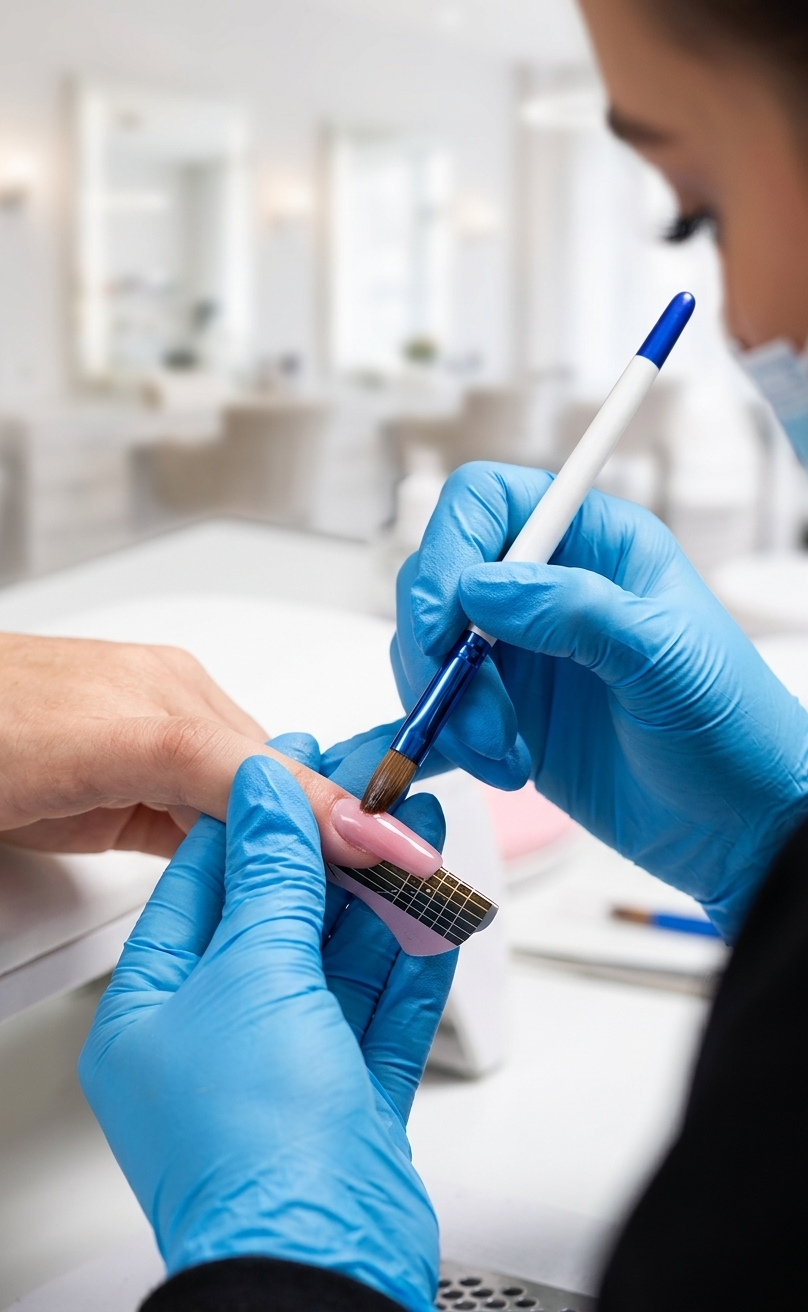
In the classroom and at the salon station, true technical mastery is always revealed in the smallest, most deliberate movements. Achieving a perfect acrylic bead consistency is not a matter of luck or guesswork; it is a precise balancing act between your liquid monomer and polymer powder. For educators and seasoned professionals alike, understanding this relationship at a molecular level is what elevates a standard service into a predictable science. Selecting premium, stable acrylic liquids provides the constant baseline required to teach and execute this foundational skill flawlessly.
The Visual Blueprint: Identifying Perfect Acrylic Bead Consistency
Controlling your liquid-to-powder ratio requires a sharp eye for texture and behavior. Before the brush even touches the nail plate, the appearance of the bead tells you exactly how the chemistry will behave during application.
- The Wet Bead (Excess Monomer): A wet bead appears completely glassy, flat, and loses its structural dome shape almost instantly on the brush tip. When placed on the nail, it runs uncontrollably into the lateral folds and cuticle area. This excess liquid means there are not enough polymer spheres to bond with, leaving unreacted monomer trapped within the structure, which inevitably leads to severe allergic micro-reactions and weak enhancement walls.
- The Dry Bead (Excess Polymer): A dry bead looks dull, chalky, and retains a heavily frosted or powdery texture around its perimeter. It refuses to self-level and requires aggressive patting with the brush to move across the canvas. Because there is insufficient monomer to fully dissolve and polymerize the powder spheres, the internal structure remains completely hollow and highly prone to fracturing under minor stress.
- The Perfect Bead: Achieving perfect acrylic bead consistency results in a smooth, satin-gloss pearl that holds a soft, rounded dome shape on the brush for three to five seconds before slowly beginning to self-level. The bead should look completely homogenized, with no visible dry powder clinging to the edges. This ideal state indicates that every polymer sphere has been perfectly saturated by the monomer, initiating a clean, dense chemical chain reaction.
Chemical Equivalence and Its Impact on Retention
When a bead is mixed improperly, the service failure does not happen days later—it is written into the chemistry the moment the product cures. Improper ratios are the primary catalyst for premature lifting, pocket lifting, and brittle snapping. As we noted in our technical guide on The Beginner’s Predictability Trap, eliminating product instability allows technicians to focus entirely on perfecting their technical application angles and control.
When the polymer grid is perfectly balanced, the acrylic cures to an optimal density that retains natural flexibility while resisting daily surface impacts. This dense, balanced matrix completely locks out external moisture and environmental contaminants, ensuring a secure bond with the natural nail bed. To further guarantee this structural link, pairing your perfect ratio with direct-from-manufacturer Adhesion Promoters & Primers creates an unyielding chemical anchor that maximizes salon retention.
Elevating Your Station Standards
At DeEnterprises, we eliminate the operational guesswork by engineering, formulating, and bottling our professional nail systems right here in West Chicago, Illinois. By maintaining absolute control over our chemical manufacturing, we deliver ultra-stable monomers and perfectly milled powders that behave identically every single time you open the bottle. This manufacturer-direct consistency ensures that when you teach or practice your bead control, your tools work with your technique rather than fighting against it.
Ready to eliminate application variables and introduce absolute chemical predictability to your salon or academy? Stock Up on These Essentials today to experience the undeniable distinction of manufacturer-direct quality and engineering.