Misunderstandings about product chemistry can lead to lifting, damage, and lost revenue. Bookmark this definitive glossary of professional nail terms to keep the facts straight, troubleshoot application issues, and elevate your technical knowledge.
The Ultimate Acrylic Nail Glossary: Professional Terms Defined
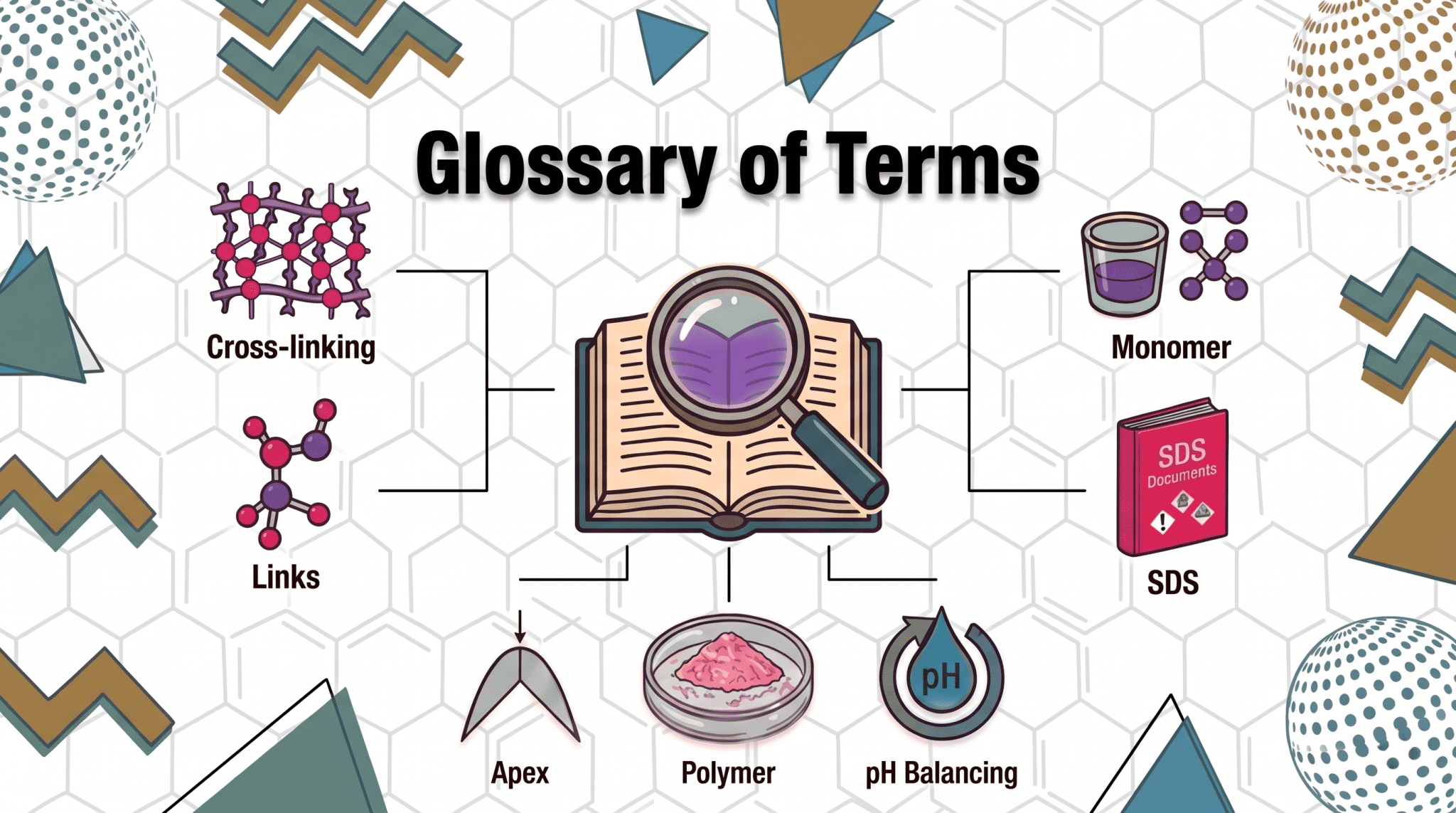
Glossary of Terms
A quick-reference dictionary of DeEnterprises terms
— A —
- Abrasive / Grit: The rough surface of a nail file used to shape or prep the nail. The lower the grit number, the coarser the file.
- Acetone: A highly effective, pure chemical solvent used to safely dissolve and break down cross-linked polymer chains for removal.
- Acrylic: A family of plastics. In the nail industry, it refers to the durable enhancement created when a liquid monomer and a powder polymer chemically react.
- Adhesion Promoter: A chemical prep liquid applied to the natural nail to maximize the bond between keratin and enhancements. In the DeEnti system, this is achieved via pH Plus Bonder or Magic Bond Primer.
- Apex (The Arch): The highest point and structural center of a nail enhancement, deliberately placed over the stress area to absorb impact and provide strength.
— B —
- Bead Ratio: The precise, proportional mixture of liquid monomer to powder polymer. A “medium” bead is the gold standard for structural integrity.
— C —
- C-Curve: The natural, horizontal arch of the nail plate when looking directly at the free edge. Enhancing the C-Curve adds significant structural strength to the acrylic.
- Catalyst: A substance that speeds up a chemical reaction. In nail chemistry, catalysts reside in the polymer powder waiting to be activated.
- Contact Dermatitis: An allergic skin reaction caused by overexposure to unreacted chemicals (like wet monomer) sitting on the living skin.
- Cross-linking: The microscopic process where monomer molecules and polymer chains weave together to form a solid, three-dimensional, damage-resistant grid.
- Curing: The complete hardening process of the chemical reaction. While acrylic “sets” in minutes, it takes up to 48 hours to fully cure to its maximum hardness.
— D —
- Dehydrator: An outdated chemical prep liquid used to temporarily draw natural moisture and surface oils out of the nail plate, tightening the pores for better adhesion.
— E —
- EMA (Ethyl Methacrylate): The primary, safe, and flexible monomer chemical used in high-quality systems like DeEnterprises’ Nomma Plus. It is the industry gold standard.
- Eponychium: The living skin at the base of the nail plate. Often confused with the cuticle, this living tissue must be pushed back, never cut or flooded with product.
- Exothermic Reaction: A chemical reaction that releases heat. As acrylic polymerizes and hardens, clients may occasionally feel a slight, temporary warming sensation.
— F —
- Free Edge: The part of the natural nail or acrylic enhancement that extends beyond the fingertip.
— H —
- Hyponychium: The living skin under the free edge of the nail that seals the nail bed from bacteria.
— I —
- Inhibitor: A chemical added to monomer liquid to prevent it from reacting or hardening inside the bottle before it is mixed with powder.
- Initiator: A chemical compound (often benzoyl peroxide in powders) that absorbs energy from the monomer and begins the chain reaction of polymerization.
— K —
- Keratin: The tough, fibrous protein that makes up the natural nail plate.
- Kolinsky Brush: A professional application tool made from natural Kolinsky hair. Its microscopic scales hold monomer liquid perfectly, which synthetic brushes cannot do.
— L —
- Lifting: When an artificial nail separates from the natural nail plate, usually caused by improper prep, moisture, or flooding the skin.
- Lunula: The visible, pale half-moon shape at the base of the natural nail, indicating the front edge of the nail matrix.
— M —
- Magic Bond Primer: DeEnterprises’ proprietary non-acid primer that acts as double-sided chemical tape between the natural nail and the acrylic.
- Matrix: The root of the nail hidden under the skin where new nail cells are created. Damage to the matrix causes permanent nail deformities.
- Mechanical Prep (Etching): The process of lightly roughing the surface of the nail plate with a file to create microscopic hills and valleys for the product to grip.
- MMA (Methyl Methacrylate): A dangerous, rigid monomer chemical banned for use in many nail salons. It causes severe natural nail damage and allergic reactions, which is why DeEnterprises strictly uses safe EMA.
- Monomer: From the Greek mono (one) and meros (part). A liquid consisting of single, free-floating molecules that act as the fuel for the acrylic reaction.
— N —
- Nail Bed: The living skin directly underneath the nail plate, rich in blood vessels.
- Nail Plate: The hard, visible, keratinized surface of the nail. This is the canvas for all enhancements.
- Nomma Plus Monomer: DeEnterprises’ signature EMA liquid, recognizable by its translucent purple tint, formulated for maximum strength and color clarity.
— O —
- Overexposure: Repeatedly allowing unreacted nail chemicals to touch the living skin, which can lead to chemical sensitivities over time.
— P —
- PH Plus Bonder: A specialized DeEnterprises treatment applied to the natural nail to raise its pH level, making it the perfect chemical environment for maximum adhesion.
- Polymer: From the Greek poly (many) and meros (part). A powder made of thousands of monomer molecules that have already been linked into long chains.
- Polymerization: The chemical reaction where liquid (monomer) and powder (polymer) combine, cross-link, and form a solid plastic enhancement.
- Primer (Non-Acid vs. Acid): A chemical adhesive. Traditional acid primers eat microscopic holes in the nail for grip, while non-acid primers (like Magic Bond) create a safer, double-sided covalent bond.
- Pseudomonas (Green Nail Syndrome): A common bacterial infection that thrives in the trapped moisture when an artificial nail lifts, causing a green stain on the nail plate.
— R —
- Rebalance (Fill): The maintenance service required every 2-3 weeks to fill in the new growth at the cuticle and reconstruct the apex for structural balance.
— S —
- Smile Line: The curved line where the pink nail bed meets the white (or clear) free edge in a French manicure or sculpted extension.
- Stress Area: The zone of the natural nail where it leaves the finger bed and becomes the free edge; the most common breaking point if not protected by an apex.
— T —
- Tacky Layer (Inhibition Layer): A slightly sticky surface occasionally left on top of cured enhancements. It occurs when oxygen in the air prevents the very top layer of molecules from completely cross-linking.
- Temperature (Ambient): The environmental heat or cold of your workspace. Since acrylic curing is a chemical reaction, higher ambient temperatures speed up the set time, while colder temperatures slow it down.
- Tip (Nail Tip): A pre-molded, ABS plastic extension applied to the natural free edge using cyanoacrylate resin to instantly add length before the acrylic structure is built on top.
- Top Coat (Sealer): The final protective layer applied over a finished enhancement. It seals the acrylic, provides a glass-like shine, and adds an extra layer of defense against scratching and staining.
— U —
- UV Stabilizers: Specialized chemical additives formulated into DeEnterprises products (like Nomma Plus Monomer) designed specifically to absorb ultraviolet light and prevent the enhancement from discoloring or degrading over time.
— V —
- Viscosity: The scientific measurement of a fluid’s thickness or resistance to flow. Monomers have a very low viscosity (they are thin and watery), which allows them to quickly and fully saturate the polymer powder spheres.
- Volatile Organic Compounds (VOCs): Chemicals that easily evaporate at room temperature. The recognizable scent of a professional nail laboratory is simply the safe, natural evaporation of the monomer liquid.
— W —
- Wet Bead: An improper bead ratio containing far too much monomer liquid. A wet bead will flood the cuticles, shrink significantly during the curing process, and cause severe lifting.
- Working Time: The specific, critical window of time a technician has to shape and sculpt the acrylic bead before the chemical reaction permanently hardens the structure.
— Y —
- Yellowing: The visual degradation of an acrylic nail. It is most commonly caused by using contaminated monomer, mixing incompatible product brands, or extreme, unprotected UV exposure.
— Z —
- Zones (1, 2, and 3): The geographical breakdown of the nail plate used in the traditional 3-Bead Method. Zone 1 is the Free Edge, Zone 2 is the Stress Area/Apex, and Zone 3 is the Cuticle.